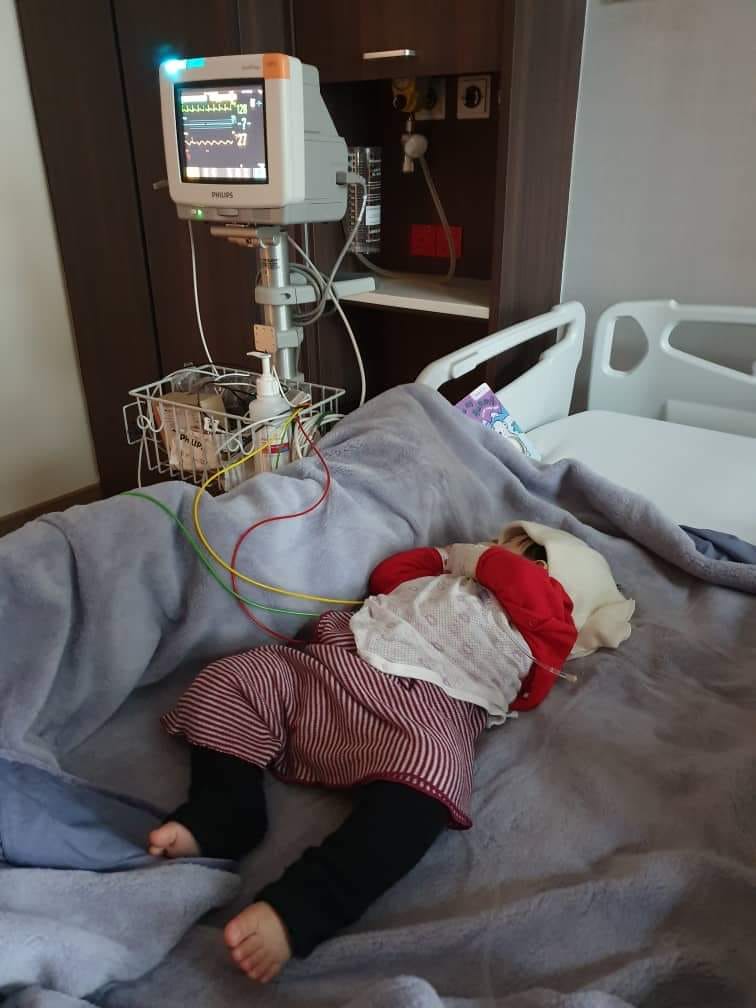
Kawasaki Disease - "The Killer Who Burned Your Baby's Heart"
Use "negative ions" to witness and share~
My husband is very protective of his children, so I have never posted about my children on social media. Many people don't even know that I gave birth to a baby. This time without his consent, I decided to make public what happened to my baby recently – Kawasaki Disease - "The Killer Who Burned My Baby's Heart"
The content is very long and if you have children under five years old, I hope you can read it patiently.
05/12/2019 Thursday - Baby has a fever
When I was holding my baby for the past few days, I felt that her body temperature was higher than usual, but when I measured her body temperature, there was nothing unusual about it. She started having a fever in the middle of the night on Thursday (38.3°c).
06/12/2019 Friday – baby sees doctor
Early the next morning, I took the baby to see her pediatrician (Dr.) Chum Kok Wai - Gleneagles Medini). The doctor prescribed antipyretics and antibiotics and asked me to give them to my baby regularly every six hours. The baby went home to take medicine and the fever subsided, but came back six hours later, and it got higher and higher (38.6°c - 39.7°c - 40.2°c).
07/12/2019 Saturday – baby admitted
On Saturday night, I decided to arrange for my baby to be admitted to the hospital for a blood test and a runny nose test.
Two hours later, the test report was released. The baby was not flu or hand, foot and mouth disease.
A difficult night At twelve o'clock in the middle of the night, the doctor came to the hospital to see the baby. As soon as he saw the baby, he said: “. Her lips are very red! ”
The doctor began to examine the baby's body and saw redness (a large circle) where the BCG was struck on her arm. The doctor immediately asked the nurse to give him the phone. He patted the red mark on the baby's arm and patted the baby's lips. Then, he said seriously: “ may be Kawasaki. ”
I panicked! What is that? Why does the doctor look so worried?
After the doctor left the ward, I hugged the baby and cried bitterly. I didn't sleep all night and read a lot of information online. Because the baby only has a fever for the third day, many symptoms have not yet appeared, and it is impossible to determine whether he really has it. ( Kawasaki is usually not diagnosed until the fifth day.) I knelt by the bed and kept praying, hoping that the baby would be safe and sound.
08/12/2019 Sunday – baby is diagnosed and treated
After finally staying up until dawn, relying on the information of “ reading ” overnight, the baby came together and I started to check the baby's body. Her eyes were not red, her hands and feet were not swollen, and her body was not rashes. The nurse comforted me, maybe not Kawasaki.
At ten o'clock the doctor came and opened her mouth and found that she was beginning to appear with a strawberry tongue (the tongue became as red as a strawberry).
This was Kawasaki's most obvious symptom, and I was preparing for the worst. The doctor suggested that we take another more expensive test, test the baby's nose, and test all viruses to see if there are other conditions. (Kawasaki cannot be known through testing and can only be determined by exclusion.)
Two hours later, the test results came out, and the baby reacted negatively to all viruses, proving that her high fever had nothing to do with the virus.
1. The fever did not subside for several days
2. Red lips and blood
3. Big red seal on the arm
4. The starting point of redness and swelling of the tongue
5. Not a viral infection
The doctor concluded that it was Kawasaki Disease Twelve difficult hours
The doctor began to arrange for the baby to be injected with IVIG (immunoglobulin). According to the doctor's oral statement, IVIG is an antibody taken from the blood of a blood donor and processed into an expensive antibody drug. IVIG is injected based on your baby's weight. My daughter weighs 10.70kg, so she needs nine bottles.
At 1:30 p.m., the baby started receiving drug injections. During this period, the baby's body will be connected to an electrocardiogram instrument to observe the baby's response to the drug.
When injecting the first bottle, the baby's body does not show red spots, indicating that the baby is not sensitive to the drug. Is good.
During the second bottle, the baby started to tremble. Her little hands kept shaking and her mouth couldn't close. She grabbed me tightly and kept murmuring “ mom mom mom mom ”. While I was crying, I hugged her tightly.
Later, the baby began to heat up, his whole body began to sweat, and the bed became wet. I cut off her clothes with scissors, wiped her body dry, and covered her with a thinner cloth.
Later, the baby begins to cough. I patted her on the back to soothe her.
I have read the information and know that these are normal reactions. My baby is very strong. She has no symptoms such as vomiting, red spots, and itching in the data. The entire injection course is twelve hours. At half past one in the morning, the nurse began to remove the electrocardiogram equipment.
09/12/2019 Monday – baby is under observation
The baby gets up at seven o'clock, and the first thing he does is find water to drink. She had not eaten at all in the past few days, and she did not want to drink milk. She only took a few sips of boiled water. Her blood was very thick. When she wanted to be tested, she had to wait for the blood to flow drop by drop. It took a long time to accumulate, and the baby cried until he was hysterical. The doctor said that the baby needs to be observed for thirty-six hours. If there is no further fever, the doctor will arrange a blood test and a heart scan.
10/12/2019 Tuesday – baby discharged
The baby has no fever, the blood test results are healthier than when he was admitted to the hospital, the heart test results are good, and the electrocardiogram test results are normal. In the evening, when the doctor was patrolling the room, he asked me: “. Do you want to be discharged from the hospital? ” My happy answer: “ of course! ”
The doctor said he would help me arrange for my baby to have his heart checked again by a pediatric cardiologist who came down from Kuala Lumpur to Johor Bahru in two weeks. After discharge, the baby will continue to take Aspirin for eight weeks. Doctors recommend that babies should not go out at all while taking Aspirin, as the situation can become tricky if they accidentally come into contact with chickenpox patients.
I checked online and it is best not to fall while taking Aspirin because there should be no wounds.
Summary
According to online data, Kawasaki Disease is uncommon, with only 8 to 67 patients per 100,000 people under the age of 5. So many pediatricians don't think about the possibility of Kawasaki. Kawasaki is not an infectious disease. So far, the medical community still cannot find the cause, so it cannot be prevented.
Kawasaki is the killer of baby hearts. The golden treatment time is within ten days. So when your baby has a high fever for more than five days, be sure to think of the possibility of Kawasaki.
Fortunately, Kawasaki is not a difficult disease and can be treated with IVIG injections.